Caregiver Interview Questions and Answers
Our team at Augusta, alongside our home care agency customers, have recently interviewed nearly 300 caregivers for jobs in the greater Los Angeles area.
We’ve had big successes. We’ve made mistakes. And so, in this post we’re sharing some of the common interview questions and the types of answers that help you improve your chances of hiring the best caregivers for your home care agency.
These tips are meant to help you improve your phone screening interview, specifically, as that is a high-volume touch with a prospective new caregiver.
In this post we’ll cover:
-
Job interviews are a mutual sales pitch. Here’s how to start your interview.
-
The basics. We’ve found that caregivers don’t always keep their resume or application up to date with some essentials. As life happens, you’ll want to get this updated from them in your phone screen.
-
Why you left your last job? A controversial question to some in the HR world these days. But, here’s what you need to know when you ask it.
-
Competency based interview questions. What is a “Competency based interview question”? Why it matters and what type of responses to look for.
Job interviews are a mutual sales pitch.
There is an inherent interdependence between a caregiver and the home care agency. After all, you wouldn’t provide home care services if you didn’t have a caregiver who was doing the daily work.
To honor this interdependence, you should ensure to highlight the benefits of your agency, position and what makes your company different. And, as is true of any sales process, you should ask questions to understand whether or not this person will actually be a good fit for your agency right now. Many caregivers may not be the right fit today, but may be in the future, so don’t burn any bridges when you reject a candidate.
Here is a recommended way of introducing your agency to a caregiver. You’ll need to insert your own company’s best benefits, but hopefully this gives you a great script to start with:
“Hi Caregiver,
It’s such a pleasure to meet you and I’m excited to get to know you a little better through this interview. I’d like to begin by sharing some of the benefits that our team of caregivers has been excited about recently. Then, I’ll have a few questions for you. And, of course I’ll leave time for any questions you may have as well. We’ll probably be about 20 minutes today. Sound OK?”
“Caregivers at my company are really special people. They love that we pay more than other agencies, starting at $18-22/hr, depending on experience, but they know that we can do this because we offer excellent, high-quality care to our clients. They have also been taking advantage of our paid training programs for initial training and ongoing training. They love our mentorship program for new caregivers and have been able to get affordable benefits after working with us for 90 days.
And probably one of our best programs for caregivers is our “float pool.” Under this program, you can earn up to $2/hr more, pick up extra shifts and at the same time you’re giving relief to your co-workers who need to take time off for their own families. So, basically getting paid while doing good!”
The Basics
The typical job seeker persona in today’s market is juggling their own family responsibilities, their family caregiving duties and two (or more) jobs. And, to put a finer point on it, caregivers typically make somewhere near $30K/yr, putting them just at the edge of the federal poverty line depending on how many people are in their family.
This means that there are a myriad of factors which may make it much harder than some to keep their resume or application updated with every job change. They may not have a computer of their own. They may have a financial hardship due to not getting paid by another employer (this is more common than it sounds, check out these interviews I recorded with caregivers to hear first hand accounts). They simply may not have been taught what a resume should look like and how to ‘sell’ themselves on it.
Reasons behind this aside, at the beginning of an interview, we always make sure we’ve understood the basics about a caregiver’s work history. However, on a phone screen, you should keep it short and get a full employment history during the in-person interview/on-boarding.
-
Could you confirm your name and best contact phone number? I have it as __________ & ____________.
-
Are you willing and able to commute to _________ town.
-
You should aim to make sure the caregivers you hire don’t have to commute to a client that is more than 5 miles from where they live. This is a common reason that caregivers turnover, the location of their client must be easy to get to.
-
-
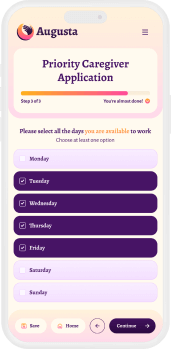
What’s your ideal schedule like? Why?
-
First, we’re all people and you need to acknowledge that this candidate has their own responsibilities: family, other jobs, etc. And, if there’s not a good match with the schedule and number of hours that the candidate is seeking, then you’ll probably lose them sooner or later. They may need money quickly and so are willing to take a schedule or client location that actually doesn’t fit in with their life. Because of this, it’s much better to be up front about how their schedule fits with your current needs.
-
Also, a pro-tip for your marketer, client care or intake coordinator, you may want to consider asking your client if they would accept other hours than requested if you can get them the perfect caregiver that has a different schedule.
-
-
Where did you find out about this position?
-
It’s important to keep track of the sources where your caregivers are finding out about the position so that you can continue to invest more in getting caregivers from those sources. If you’re not familiar with that type of tracking, here’s another article I wrote about managing your hiring funnel.
-
-
What made you decide to apply for this position? / Why do you want to be a caregiver?
-
This question is subjective, though when asked systematically, you’ll find themes to the answers. But, after the amount of interviews I’ve done, I don’t believe that this question predicts future behavior. But that being said, these are the few main themes you’ll hear:
-
Caregivers in need of money asap. This group might just be more honest with you about where they are at. If their work history and other experiences is strong, why make this a barrier to starting with your company? If anything, they’re motivated, right?
-
Caregivers who have always done it and love to help people. I think this is the most popular answer to this question and one
-
Caregivers who want to break into healthcare. Often, this group is in school for something in the medical field already. We’ve found not always long-term employees, but while they’re with you, they’re top notch.
-
-
Competency Based Interview Questions
A competency based interview question is one which prompts the interviewee to give real-life examples of their skills.
These are probably the best questions I’ve found for getting a good grasp on whether or not this caregiver will actually be a fit for the current need. The reason being, they ask about specific events, with examples, and it’s well documented that the best predictor of future behavior is past behavior.
Our recommended competency-based questions on a phone interview:
-
Tell me about your last 2-3 positions. What were you hired to do? And how long were you there?
-
Tell me about a time when you had a difficult situation and how you handled it.
If, in the last two of three positions they were only there for a week, their is a pretty strong chance that they will only be with you for a week, too.
The question on “what they were hired to do” is simply to gauge their level of ability to communicate common tasks on the care plan. Most people need training and retraining on personal care skills and documenting etc, but at least you’ll know where you’re starting from.
A final word about these important example or employment history questions:
-
There are a lot of people out there who “can’t think of an example” in the moment. Give them a little more time and try to rephrase the question one or two times.
-
Rephrasing might sound like: “Imagine you are back caring for your family member that you told me you cared for… during your day to day, were there times when it was hard to give them the care you knew they needed? What happened?”
-
-
If some one has a lot of caregiving experience and finds it hard to give an example, then sometimes I’ll prompt them a little with my own caregiving example. That’s my last resort, however, because they could get psychologically anchored to my example.
Why did you leave your last job?
This question has become a bit more of a controversial one in recent history (post pandemic). With so many people leaving the workforce, it’s become increasingly common to see gaps in the typical caregiver’s work history.
And, if you were to google search “best answer to the interview question why did you leave your last job” you will find a whopping 226 Million results.

This is because the answer to this question is one people tend to try and “game” an answer to. For most people, when they leave a job its because they or the company weren’t right right fit for their skills and needs at the time.
For caregivers to stay with your agency, they need to have a good relationship with their manager and the schedulers, their client location needs to be convenient, their schedule needs to be manageable with their life and they need to have a clear pathway to increase their pay and standing over time. Since it’s a complex set of requirements, there are many reasons why they may have left their last position which are completely justifiable.
So, I would challenge you to consider what you want to get out of this question, if you ask it. Are you worried that they were fired for their last job because they committed a crime at work? Understandable, but… that’s why background checks exist for caregivers. Rather, we recommend focusing on how you can help this person gel with your team and culture and getting them into your path toward professional growth.
What are the best interview questions to ask caregiver applicants?
The best caregiver interview questions focus on communication skills, reliability, scheduling needs, work history, and real-life caregiving experience. Many home care agencies use competency-based interview questions that ask candidates to describe how they handled difficult situations, cared for clients, or managed challenges in previous roles. These questions help agencies better predict future performance and cultural fit.
What are competency-based interview questions in home care?
Competency-based interview questions ask caregiver applicants to provide specific examples from past experiences rather than hypothetical answers. For example, an interviewer may ask, “Tell me about a difficult caregiving situation and how you handled it.” These questions are valuable because past behavior is often one of the strongest indicators of future job performance in caregiving roles.
Why is the phone screening interview important for caregiver recruiting?
Phone screening interviews help home care agencies quickly identify qualified caregivers, confirm scheduling and commute compatibility, and improve hiring efficiency before moving candidates to in-person interviews. Since caregiver recruiting is often high-volume and time-sensitive, phone screens allow agencies to assess communication skills, professionalism, and availability early in the process.
*REMINDER: Phone screening is a valuable tool to save agencies time, but the most valuable caregiver-recruiter connections come from in-person interviews. According to Augusta's 2025 Q4 Benchmark Report, over half of caregiver hires were interviewed in-person.
How can home care agencies improve caregiver interview success?
Home care agencies can improve interview success by creating a structured interview process, communicating clearly about pay and benefits, and highlighting what makes their agency different. Agencies that treat interviews as a two-way conversation — where both the caregiver and employer evaluate fit — often create a stronger candidate experience and improve long-term retention.
Why do caregiver commute distance and scheduling matter in hiring?
Commute distance and scheduling compatibility are major factors in caregiver retention. Caregivers who travel long distances or work schedules that conflict with their personal responsibilities are more likely to leave quickly. Many agencies find that caregivers are most successful when assigned to clients located close to where they live and when schedules align with their availability.
Augusta helps agencies geo-qualify candidates based on their zipcode and the location of your service area (the placement of your office and your clients). By automatically screening for optimal locations, your agency focuses more time on qualified applicants.
Should home care agencies ask why a caregiver left their last job?
Many agencies still ask why caregivers left previous jobs, but the question should be approached carefully and without judgment. Caregivers may leave positions for many legitimate reasons, including scheduling conflicts, commute challenges, family responsibilities, or lack of growth opportunities. Instead of focusing only on past employers, agencies often benefit more from understanding how they can support caregiver success and long-term growth.
What makes caregivers stay with a home care agency long term?
Caregivers are more likely to stay with agencies that provide supportive management, flexible scheduling, convenient client assignments, competitive pay, professional development opportunities, and clear communication. Positive workplace culture and strong relationships with schedulers and managers also play an important role in caregiver retention and job satisfaction.