How to Find and Use Your Ideal Caregiver Profile (ICP)

How to Find and Use Your Ideal Caregiver Profile (ICP)
Most home care agencies think their staffing problem is simple: we need more caregivers.
But if you’re dealing with churn, no-shows, and unstaffed cases, the issue isn’t quantity—it’s clarity.
In this article, we’ll break down how to use the caregiver applicant data you already have to find your “best fit” applicant… your Ideal Caregiver Profile (ICP).
Step 1: Stop Guessing—Your ICP Already Exists
Many agencies try to define their “ideal caregiver” based on wishful thinking: perfect experience, perfect personality, perfect availability.
That’s not your ICP.
Your Ideal Caregiver Profile (ICP) is who you hire and retain consistently.
How to Find Your ICP
Start by looking at your real data:
- Who got hired?
- Who stayed?
- Who quit, no-showed, or didn’t work out?
The difference between those groups is your ICP.
Step 2: Identify the Patterns That Actually Matter
Once you have 3-5 applicants of each group, compare them based on key factors:
1. Commute
- Where do they live?
- How far are they traveling?
- Are there geographic barriers (like highways or traffic patterns)?
👉 You may find that caregivers living 25+ miles away consistently struggle or churn.
2. Hours & Expectations
- How many hours were they hired for?
- How many hours are they actually working?
Mismatch here is one of the biggest drivers of turnover.
3. Client Fit
- What types of clients do they have experience with?
- What clients are they actually assigned to?
Misalignment between experience and assignment leads to frustration—for both caregiver and client.
4. Pay Expectations vs. Reality
- What did they expect to earn?
- What are they actually earning?
Even small gaps here can lead to disengagement or early exits.
Then, Look at What Didn’t Work.
Here’s an example dataset:
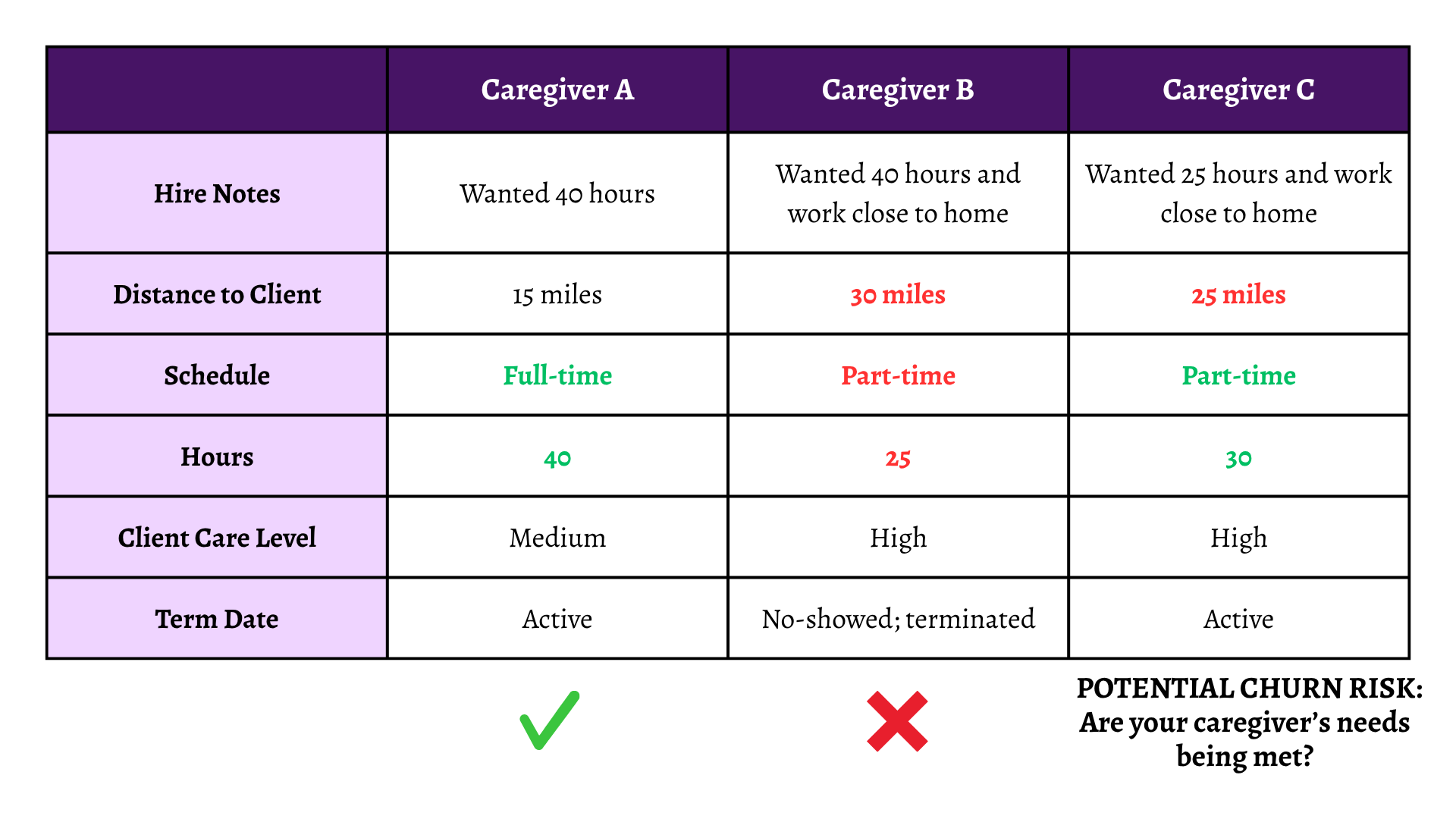 Ask yourself:
- What happened?
- Was there a mismatch?
- What could have been caught earlier?
In this case, we can see that the caregivers who were hired and retained are working close to their expected hours and live within 15 miles of a client.
This exercise helps you identify red flags before hiring, instead of reacting after the damage is done.
Step 3: Align Your Entire Team
ICP isn’t just a recruiting tool—it’s a company-wide alignment tool.
It’s not just your Recruiting Team who should be participating in this ICP exercise, because the caregivers you hire impact your entire agency.
Hiring and retention are the same problem.
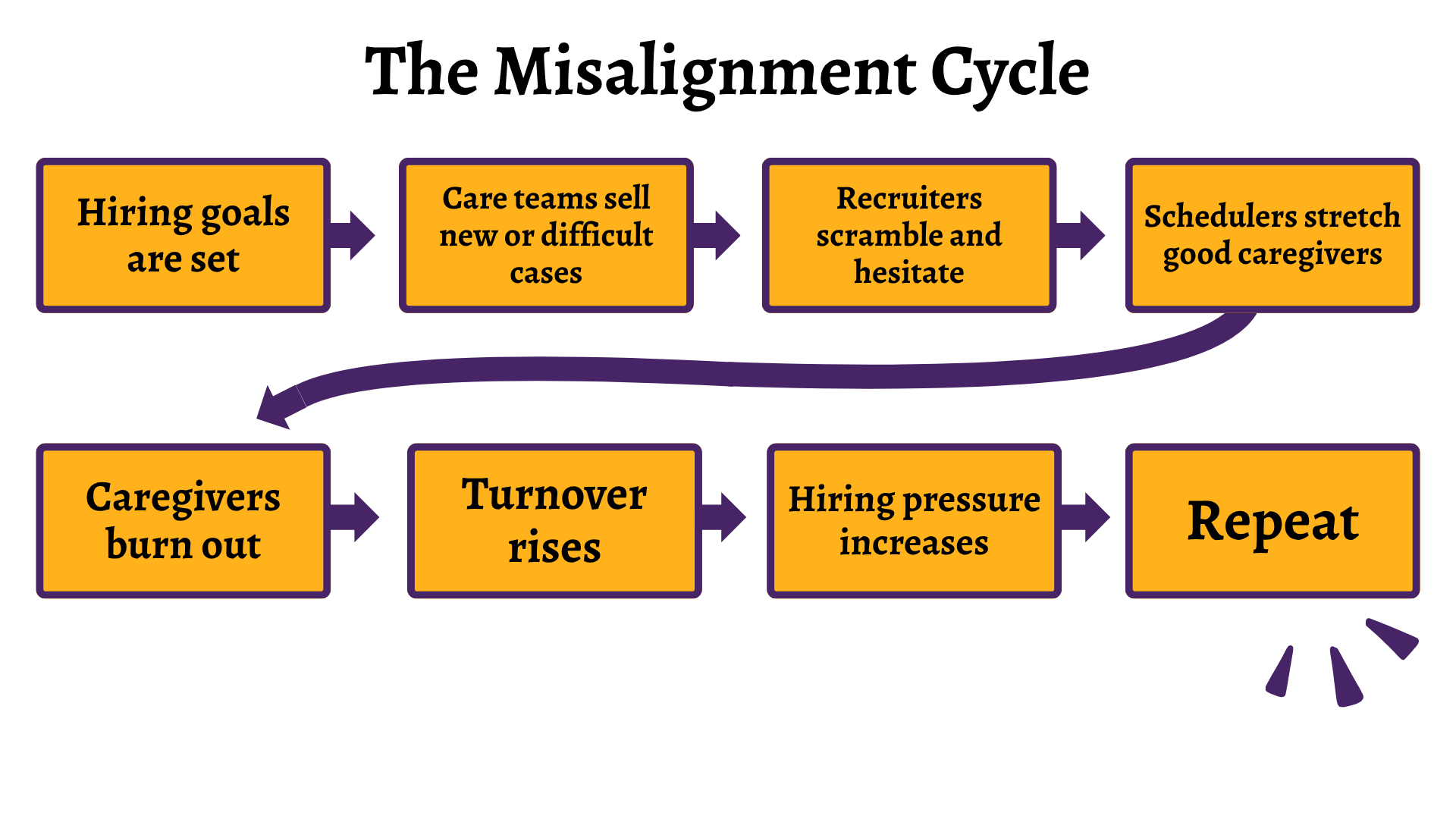
Refusing to align your recruiting, sales, and scheduling teams can result in your agency getting trapped in a cycle of poor-fit caregivers.
However, when you hire with your clients and your Ideal Caregiver Profile in mind, you:
- Ensure you’re meeting your caregiver’s needs
- Ensure your meeting your client’s needs
- Create stronger caregiver/client bonds that increase retention, even after the client has passed on
Step 4: Use Your Systems to Operationalize ICP
It makes sense to consider the entire staffing funnel when you’re hiring a new caregiver, but the reality is often more complicated than that. Time is money, and your ICP only becomes usable once you’ve spent the time calculating it.
Regardless, hiring using your ICP is a worthwhile investment for agencies of all sizes.
To save time, start the exercise outlined above with just 3-5 caregiver applicants—you should be able to see patterns emerge from just that sample size.
Tools like Augusta can also help save time. The Augusta Smart Application captures rich applicant data, creating a searchable Candidate Pool for your recruiting, sales, and scheduling teams. This article goes into more detail of how to use your ICP with Augusta’s Candidate Pool.
This makes it easier to:
- Track and document caregiver attributes in your candidate pool
- Flag applicants who match your ICP—even if you don’t hire them immediately
- Re-engage them when the right opportunity comes up
Final Thought: Better Hiring Starts With Better Clarity
If you take one thing away, let it be this:
You don’t need more caregivers. You need better alignment between caregivers, clients, and expectations.
Using your ICP doesn’t just make for better hiring—it makes for a better agency.
FAQ
What is an Ideal Caregiver Profile (ICP)?
An Ideal Caregiver Profile (ICP) is a data-driven description of the caregivers who are most successful at your agency. Instead of focusing on an idealized candidate, an ICP is built by analyzing which caregivers were hired, stayed with the agency, and performed well over time. It helps agencies make better hiring decisions based on real outcomes rather than assumptions.
How do home care agencies identify their Ideal Caregiver Profile?
Home care agencies can identify their ICP by reviewing caregiver hiring and retention data. Start by comparing caregivers who were successfully hired and retained against those who quit, no-showed, or were not a good fit. Look for patterns related to commute distance, availability, client assignments, work hours, and pay expectations. These trends often reveal the characteristics of caregivers who are most likely to succeed.
Why is an Ideal Caregiver Profile important for caregiver retention?
An ICP helps agencies hire caregivers who are more likely to stay long term. By identifying common retention drivers—such as manageable commutes, realistic scheduling expectations, and strong client matches—agencies can reduce turnover, improve caregiver satisfaction, and create more stable staffing for clients.
What factors should be included in a caregiver ICP?
The most effective caregiver ICPs typically include factors such as commute distance, preferred work hours, scheduling availability, client care experience, pay expectations, and geographic location. Agencies may also evaluate communication skills, reliability, and compatibility with their client population. The goal is to identify the traits that consistently lead to successful placements and long-term retention.
How does commute distance affect caregiver retention?
Commute distance is one of the strongest predictors of caregiver retention. Caregivers who travel long distances to client assignments are often more likely to experience burnout, scheduling challenges, and turnover. Many agencies find that caregivers who live closer to their clients are more likely to remain engaged and stay with the agency longer.