Why Your Sales Team Might Be Costing You Money

The Importance of Sales and Recruiting Alignment for Home Care Agencies
Most home care agencies don’t have a caregiver shortage, they have a coordination problem.
When a care coordinator visits a prospective client, they’re promising reliable care — they’re selling peace of mind. But what happens when they return to the office and realize there’s no caregiver available to staff that case?
That promise doesn’t disappear, it gets pushed downstream.
Recruiters are pressured to “make it work.” What follows is predictable:
- Caregivers are placed into mismatched cases
- Existing staff are pressured into overtime
- Call outs and no-shows increase
- Turnover follows
How do you know if your sales team is selling caregivers you don’t actually have?
The Hidden Cost of Overpromising Care
Too often, recruiters and care coordinators act independently of one another — so independently, in fact, that they don’t know the needs of the other team.
If recruiters don’t bring in caregivers, sales can’t staff clients. If sales doesn’t bring in clients that match available caregivers, recruiters can’t retain hires.
The following caregiver shortage isn’t bad luck. It’s a bad alignment.
That’s why Augusta emphasizes client–caregiver matching. You’re not just finding clients. You’re not just hiring caregivers. You’re collecting the right information from the right caregivers to create matches that actually last.
What Is an Ideal Customer Profile (ICP)?
This is exactly why high-performing home care agencies rely on a clearly defined Ideal Customer Profile (ICP). An ICP forces discipline into the sales process by asking one critical question:
Is this customer right for our business?
Selling home care services to a client who lives 40 miles away from any caregiver on your roster might be a success for sales…
But long commutes lead to fatigue, lateness, missed shifts, and eventually resignation. The client suffers. The caregiver burns out. The agency pays twice.
For home care agencies, ICP factors often include:
- Ability to afford services or meet a minimum number of care hours
- Alignment with the services your agency provides (medical vs. nonmedical and acuity level)
- Location
- Schedule
Here are three core ICP filters every agency should consider:
💰 Cost Match
Does the client understand the cost of care? Are they financially prepared for ongoing services, or is there a high risk of sudden cancellation?
🩺 Service Match
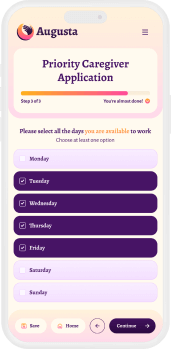
Do they require services your caregivers are certified and comfortable providing? Do you have caregivers available during the required days and times?
📍 Geoqualified
Is the client within your service area — and do you have caregivers nearby?

Over 70% of caregivers hired through Augusta live within 20 miles
of a given agency’s service area — a good indicator of how far most
caregivers are willing or able to travel for work.
Without an ICP filter, agencies make short-term decisions that create long-term damage.
The Fix: Bridging the Gap Between Sales and Recruiting
Alignment doesn’t require more meetings. It requires shared data and transparency.
When both teams can see the same caregiver pool, decisions improve. Care coordinators can confirm availability before setting expectations with a client. Recruiters can prioritize candidates based on real staffing needs — not guesses.
One way to remedy this is through Augusta. In the Augusta dashboard, agencies can view their bench of qualified caregivers and identify immediate matches. They can also manage future talent in the Candidate Pool as needs change.

Another good strategy is to review your agency’s needs weekly. Have recruiters, care coordinators, schedulers, trainers, and the overall team meet and discuss:
- What new clients are starting services in the next few weeks?
- What existing clients are increasing or decreasing hours?
- What caregivers are complaining about shifts?
- What clients are complaining about caregivers?
- What caregivers are at risk of overall termination?
These points should guide your team towards a shared understanding of your work. You’ll get ahead of repairing relationships with caregivers and clients, identify risks in your pipeline, and prevent uncertainties from becoming emergencies.
No matter what tools you use, the goal is the same:
Keep everyone informed about what resources you actually have.